
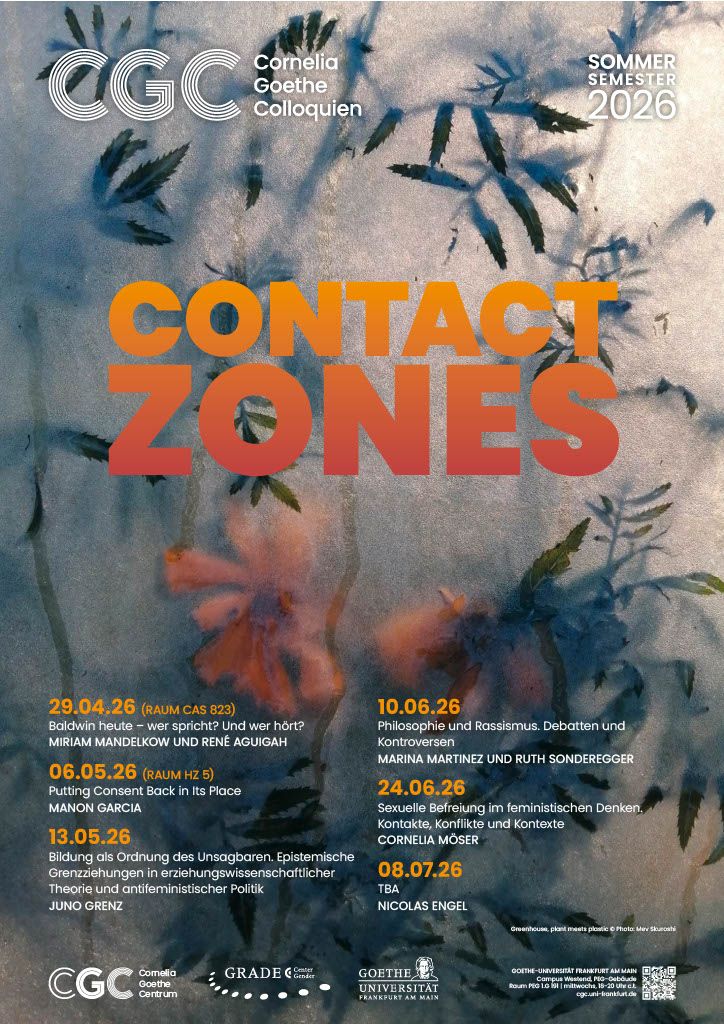
Greenhouse, plant meets plastic © Photo: Mev Skuroshi
1.G191, unless otherwise stated
Knowledge migrates. It diffuses, is modulated, and translated. It becomes embedded in cultural and social contexts, interwoven with contingencies, yet remains embedded in social power relations. More than ever, the context of current social developments reveals how closely the migrations of knowledge are linked to the possibilities of epistemic agency. Questions from the fields of feminist and postcolonial philosophy and the critique of science are thus regaining significance right now: Who can act as a subject of knowledge and be heard, and how? Which experiences are invoked in which contexts? And what claims to validity are tied to them?
Knowledge from social movements that challenges the status quo has found its way into critical theories and, consequently, into academia. At the same time, critical knowledge and critical scholarship face immense challenges, as evidenced, for example, by political attacks. Furthermore, the growing power of AI is currently devaluing intellectual labor.
The dissemination of knowledge that enables, conveys, interprets, and distinguishes diversity is thus countered by a devaluation of these very forms of knowledge.
Feminist and postcolonial approaches have, in various contexts, introduced a critical conception of translation to describe social spaces where bodies, language, knowledge, and experiences intersect, as well as the possibilities and limits of mediation and understanding under conditions of asymmetrical power and violence. Translations occur in various directions and are always linked to the enabling of alterity, to the limits of understanding, and to encounters between different groups and frames of reference under conditions of asymmetrical power relations. Such ideas have been taken up in translation studies as well as in the humanities, cultural studies, and educational theory to rethink the contextuality of knowledge and claims, as well as epistemic violence. Building on critical theories that have emphasized the situated nature of knowledge—including, in particular, queer-feminist, post- and anti-colonial, and poststructuralist approaches — this CGC colloquium focuses on the contradictory contact zones where dominant knowledge and the concepts that critique this dominance intersect. The focus is particularly on critical analyses of androcentrism and logocentrism, as well as the heteronormativity and coloniality of terms, concepts, and the associated relationships. The analysis and discussion focus not only on academia but also on literature and journalism. For “culture” is not merely a sphere in which resistance can be articulated: it currently constitutes an important arena in which political power struggles are prepared and waged.
| Attachment | Size |
|---|---|
 Poster CGColloquia summer term 2026 [german] Poster CGColloquia summer term 2026 [german] | 2.8 MB |